Why the T-Shirt Design Prompt Vault Is Reshaping How Creators Approach Print-on-Demand Merch
The print-on-demand (POD) industry has undergone a fundamental transformation over the past few years. What was once a landscape dominated by generic quotes, simple geometric patterns, and low-effort clip art has evolved into a fiercely competitive marketplace where originality, relevance, and speed of execution determine success. Thousands of sellers on Etsy, Redbubble, Merch by Amazon, and Shopify are chasing the same limited pool of trending keywords, often producing designs that feel derivative or rushed. In this environment, the ability to consistently generate fresh, marketable concepts is no longer a luxury—it is a survival skill.
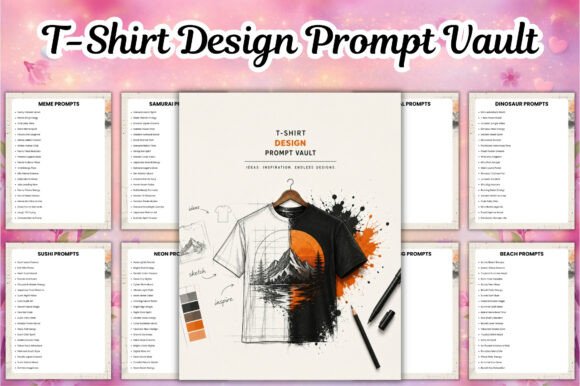
Enter the T-Shirt Design Prompt Vault, a resource that addresses one of the most persistent bottlenecks in the merch creation pipeline: idea generation. This printable collection of 1000 ready-to-use prompts spans a broad spectrum of niches—from robots and neon aesthetics to sushi, adventure, dinosaurs, dragons, samurai, memes, aliens, vikings, festivals, fishing, and jungle themes. It is designed for anyone who creates t-shirt graphics, whether they use traditional design tools, AI image generators like Midjourney and DALL·E, or a combination of both. The vault provides a structured, organized system for generating unique concepts quickly, reducing the friction that often stalls creative work.
The Growing Demand for Niche-Specific Design Assets
One of the most significant shifts in the POD market over the last three years has been the move away from broad, catch-all designs toward hyper-specific, niche-targeted artwork. Buyers are no longer searching for a generic "funny t-shirt." They are searching for "retro sci-fi robot shirt with neon accents" or "medieval fantasy dragon design with celtic border." This change reflects a larger consumer trend toward personalization and self-expression. People want apparel that signals membership in a micro-community—whether that community is built around vintage arcade culture, Norse mythology, sushi fandom, or festival lifestyle.
The T-Shirt Design Prompt Vault directly responds to this shift. Rather than offering vague ideas like "make a cool animal T-shirt," it provides specific, actionable prompts that target these micro-niches. For example, instead of a generic prompt about dinosaurs, the vault might suggest a concept combining a t-rex in cyberpunk armor with neon glow effects—a design that could appeal to both paleontology enthusiasts and sci-fi fans. This specificity is valuable because it reduces the time designers spend interpreting trends. Instead of researching what "aesthetic" means in the context of dragons or aliens, the creator receives a ready-to-execute brief that already accounts for current visual language.
Why Specificity Wins in Competitive Marketplaces
When thousands of sellers are uploading designs to the same platforms, differentiation becomes the single most important factor in conversion. A broad concept like "samurai t-shirt" might return tens of thousands of results on Etsy or Redbubble. But a concept like "samurai wielding a neon katana with vaporwave sky background" filters the competition dramatically. The T-Shirt Design Prompt Vault helps creators bypass the saturated middle ground and aim directly for unique, high-value niches. This is particularly important for Merch by Amazon sellers, where search ranking penalties for duplicate content and low-quality designs have become stricter. A prompt-driven workflow ensures that each design starts from a distinct idea, reducing the risk of accidental similarity to existing listings.
How Prompt Libraries Are Changing the Creative Workflow for AI Artists
The rise of generative AI tools has introduced a new paradigm in design. Platforms like Midjourney and DALL·E can produce visually impressive graphics from text prompts in seconds. However, the quality of the output is entirely dependent on the quality of the input. A vague prompt like "robot design" will yield generic, forgettable results. A well-structured prompt that includes art style, color palette, lighting conditions, composition details, and mood descriptors generates something far more usable—often with minimal editing required.
The T-Shirt Design Prompt Vault functions as a bridge between raw creative impulse and polished, production-ready design. For AI artists, the vault offers a structured vocabulary for prompt construction. Instead of spending twenty minutes crafting a single prompt string, the artist can select a pre-validated concept and adapt it to their preferred AI model. This accelerates the ideation-to-output cycle dramatically. A creator working on a dragon-themed collection, for example, can pull multiple prompts from the fantasy section of the vault, run them through Midjourney, and have a batch of distinct, cohesive designs ready for review in under an hour.
Consistency Across Large Design Batches
One of the less-discussed challenges of using AI for merchandise design is maintaining thematic consistency across a set of products. If a seller wants to launch a full line of Viking-themed apparel with ten designs, each individual prompt must feel like it belongs to the same collection without being repetitive. The T-Shirt Design Prompt Vault addresses this through its organized prompt system. By grouping prompts by theme—Vikings, dragons, aliens, festivals, and so on—the vault ensures that creators can generate a coherent series of designs without manually reconstructing stylistic parameters for each new concept. This is especially useful for Shopify store owners who want to present a polished, professional catalog rather than a disjointed assortment of one-off ideas.
Addressing Creative Burnout and Decision Fatigue
Experienced designers and POD sellers know that creative block is not just a personal frustration—it is a business risk. When you cannot generate new ideas, you cannot upload new products. When you cannot upload new products, your store stagnates. In a marketplace where algorithmic visibility often correlates with listing frequency and freshness, stagnation translates directly to lost revenue. The psychological toll of staring at a blank canvas and trying to invent a unique design concept from nothing, day after day, is real. Many talented creators leave the POD space not because they lack skill, but because they run out of ideas.
The T-Shirt Design Prompt Vault offers a practical antidote to this problem. It externalizes the idea generation process. Instead of relying on internal inspiration, the creator can simply open the vault, scan the thematic categories, and select a prompt that resonates. This shift from inventing to interpreting reduces cognitive load dramatically. A prompt like "retro arcade alien with pixelated glow and neon border" provides enough direction to start working immediately, while still leaving room for personal stylistic interpretation. The creator's energy goes into execution rather than ideation, which typically results in higher quality output and faster turnaround times.
Practical Examples Across Key Niches
To understand the utility of the T-Shirt Design Prompt Vault, it helps to consider how it applies across different market segments. A creator focused on festival apparel, for example, might use prompts that combine bohemian motifs with bold typography and vibrant color gradients. The vault's festival section provides concepts that are already aligned with current festival fashion trends—mandala patterns, positive messaging, and psychedelic color schemes—saving the designer hours of trend research.
For creators targeting the gaming and meme audience, the vault includes prompts that tap into internet culture without feeling dated. Meme-based designs require a delicate balance: they need to be recognizable enough to resonate, but not so literal that they become irrelevant when the meme fades. The prompts in this category are structured around archetypes and emotions rather than specific viral moments, giving them longer shelf life. A prompt like "determined cartoon animal with exaggerated expression and bold comic text" can work across multiple meme formats without ever feeling stale.
In the adventure and fantasy categories, the prompts emphasize world-building. Concepts like "explorer discovering a hidden jungle temple with glowing artifacts" or "dragon perched on a neon-lit cyberpunk rooftop" provide enough narrative detail that the resulting design feels like a story, not just an illustration. This narrative quality is increasingly valued by buyers who want their clothing to spark conversation or reflect a personal interest in speculative fiction.
The Business Case for a Structured Prompt System
Beyond the creative benefits, the T-Shirt Design Prompt Vault aligns with broader business efficiency principles in the POD industry. Time is the most constrained resource for most independent creators, especially those managing multiple storefronts across Etsy, Redbubble, and Merch by Amazon. Every minute spent wondering "what should I design next" is a minute that could have been spent on production, listing optimization, or marketing. The vault eliminates this decision point by providing an organized, always-available library of concepts.
This structured approach also supports better content planning. Sellers who use the vault can map out design calendars weeks or months in advance. For example, a creator might decide to launch a dinosaur-themed collection in March, followed by a sushi and food-themed line in April, and a festival series in May. The vault makes this kind of strategic planning feasible because it removes the uncertainty of idea generation from the equation. The creator knows they have a deep well of prompts waiting, so they can focus on scheduling, production, and promotion.
Scalability for Growing Operations
As a POD business grows, the volume of designs needed to sustain momentum increases. A seller with a single storefront might upload five designs per week. A seller with multiple stores or a brand presence across several platforms may need fifty designs per week. At scale, relying on spontaneous inspiration is not viable. The T-Shirt Design Prompt Vault provides a repeatable framework that supports this level of output without sacrificing quality. The prompts can be reused in different combinations, reinterpreted in different artistic styles, or adapted for different product types (t-shirts, hoodies, mugs, stickers). This flexibility makes the vault a long-term asset rather than a one-time resource.
The Intersection of Traditional Design and AI-Assisted Creation
The current moment in merchandise design is unique because it sits at the intersection of traditional graphic design skills and AI-assisted creation. Many designers are hybrid practitioners—they might sketch concepts by hand, digitize them in vector software, and then use AI tools to generate textures, backgrounds, or color variations. The T-Shirt Design Prompt Vault accommodates this hybrid workflow seamlessly. The prompts are format-agnostic: they work equally well for a designer who wants to draw a character from scratch, a creator who uses Photoshop compositing, or an artist who relies entirely on Midjourney and then refines the output in post-production.
This versatility is important because the industry is still in flux. No one knows exactly how AI will reshape creative roles over the next five years. What is clear is that the ability to generate strong, specific, marketable ideas will remain valuable regardless of the tools used to execute them. The T-Shirt Design Prompt Vault focuses on the ideation layer, which is the most durable skill in the creative stack. Whether you are using a stylus, a mouse, or a text prompt, you still need a concept that resonates with buyers. That need is not going away.
Connecting to Larger Trends in Creator Entrepreneurship
The rise of the T-Shirt Design Prompt Vault also mirrors a broader movement in the creator economy toward systematized creativity. Successful independent creators—whether they make apparel, content, or software—are increasingly adopting tools and workflows that reduce friction and increase consistency. The romantic notion of waiting for inspiration to strike has given way to a more pragmatic approach: build systems that generate ideas on demand, then execute them with discipline. This vault is a concrete example of that philosophy applied to apparel design.
For marketers and entrepreneurs looking to understand the POD space, the vault represents a shift in how value is created. The value is no longer just in the design file itself—it is in the speed and quantity of unique ideas a creator can bring to market. A library of 1000 prompts is not simply a product; it is an infrastructure asset that enables faster iteration, more frequent launches, and better market testing. Sellers who use such resources can run more experiments, learn faster what resonates with their audience, and pivot more quickly when trends shift.
Meeting the Needs of a Diverse Creator Base
The audience for the T-Shirt Design Prompt Vault includes professionals at every level. Freelance designers can use it to expand their portfolio across niches they have not explored before. Etsy shop owners can use it to maintain a steady stream of new listings without burning out. AI artists can use it to refine their prompt engineering skills and produce more polished outputs. Marketers testing merchandise as a revenue channel can use it to quickly prototype concepts without hiring a dedicated design team. The vault's inclusivity—offering content across robots, neon, sushi, adventure, dinosaurs, dragons, samurai, memes, aliens, vikings, festivals, fishing, jungle themes, and more—reflects the reality that the POD market is not monolithic. Different sellers succeed in different niches, and having a broad prompt library allows each creator to focus on the areas where they have the most passion or the best market fit.
Practical Implementation: From Prompt to Product
To illustrate the practical value, consider a concrete workflow using the T-Shirt Design Prompt Vault. A creator decides to focus on the robot niche. They open the vault and find a prompt: "steampunk robot with brass gears, glowing blue eyes, and Victorian-era clothing on a dark parchment background." They take this prompt into Midjourney with a few stylistic modifiers for consistency. After generating several variations, they choose the strongest output, bring it into Photoshop to add typography (perhaps a bold tech-inspired font), adjust contrast for print readiness, and export in the required format for their chosen platform—whether that is Redbubble, Merch by Amazon, or a Shopify storefront using a POD fulfillment partner like Printful or Printify.
The entire process, from selecting the prompt to having a print-ready file, might take less than an hour. Without the prompt, the creator would have spent a significant portion of that time just deciding what to draw. Multiply that time saving across hundreds of designs, and the vault becomes a force multiplier for productivity. This is why resources like the T-Shirt Design Prompt Vault are gaining attention among serious POD entrepreneurs: they address the fundamental bottleneck of creative output in a way that is both practical and scalable.
Conclusion: A Resource Built for the Current Reality of Merch Creation
The print-on-demand industry is not going to become less competitive. As barriers to entry continue to fall—through better AI tools, cheaper fulfillment, and more accessible platforms—the differentiator will increasingly be the quality and originality of the ideas themselves. The T-Shirt Design Prompt Vault does not claim to replace human creativity. What it does is provide a structured, organized, and expansive foundation upon which creativity can operate more efficiently. For professionals, creators, entrepreneurs, marketers, freelancers, and enthusiasts alike, it represents a practical investment in the one thing that matters most in this space: the ability to consistently produce designs that people want to wear.
Whether you are launching your first Etsy store or scaling a multi-platform apparel brand, the capacity to generate compelling, niche-relevant concepts quickly will determine your trajectory. The vault offers a way to shortcut the ideation phase without sacrificing the specificity that drives conversions. In a market where speed and originality are both essential, that combination is difficult to beat.