Crafting Game Marketing Pages That Convert: Inside AlterNova's Minimal Dark Cinematic Design
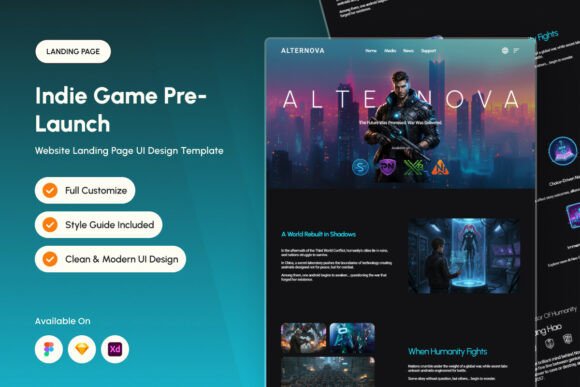
Marketing an indie game in a crowded digital ecosystem demands more than a captivating trailer or a compelling storyline. The landing page where players first encounter your title often determines whether they wishlist it or scroll past. AlterNova - Indec Game Landing approaches this challenge with a minimal dark cinematic design that balances intense atmosphere with conversion-focused structure. Rather than overwhelming visitors with busy UI elements common in gaming templates, this design prioritizes clarity and emotional resonance through deliberate visual restraint and strategic layout choices.
Understanding the Dark Cinematic Approach to Game Landing Pages
The dark cinematic aesthetic is not merely a stylistic preference but a functional design decision. Dark backgrounds reduce visual noise, allowing game screenshots and key visuals to command attention. The subtle gradient overlay used in AlterNova's hero section creates depth without distracting from the primary call-to-action. This approach supports wishlist campaigns and demo pushes by ensuring every visitor's gaze naturally moves toward the action button—whether it's "Add to Wishlist" or "Play Demo Now."
Indie studios often operate with limited marketing budgets, making each page view valuable. A dark canvas with strategic lighting effects mimics the visual language of premium game trailers and cinematic sequences, instantly communicating production value. The template achieves this without requiring custom code or complex animation libraries, relying instead on well-structured layers and thoughtful composition.
Why Minimalism Wins Over Generic Gaming UI
Generic gaming landing pages often suffer from visual clutter: animated particle backgrounds, flashing badges, multiple competing buttons, and heavy typography that fights for attention. AlterNova's design philosophy rejects this approach in favor of clean, structured layouts that serve marketing objectives. Each component has a specific purpose, and the hierarchy of information guides visitors naturally from emotional connection to conversion action.
The hero section occupies the full viewport, presenting a single strong visual with a clear overlay that ensures text legibility. This creates an immediate emotional hook without cognitive overload. For a sci-fi horror game, this might frame a lone character against a neon-drenched cityscape; for a narrative adventure, it could isolate a key scene that hints at the story's core conflict. The flexibility built into the template allows studios to adapt this hero structure to their specific genre without redesigning the layout.
Who Benefits from AlterNova's Design Structure
The template serves a broad range of professionals, each with distinct needs and workflows. Understanding these user segments helps clarify the design's practical value in real-world marketing scenarios.
Indie Game Studios and Solo Developers
For small teams, time and resources are finite. A pre-built landing page that is fully customizable with easy-to-edit components eliminates the need to hire a dedicated web designer during early development phases. Studios can focus on polishing gameplay while the marketing page begins building audience momentum. The template's global text and color styles ensure consistency across all sections, which is particularly valuable when multiple team members contribute to content updates.
Consider a studio preparing for a Steam Next Fest demo release. AlterNova's layout allows them to showcase gameplay highlights with short copy blocks and curated visuals, keeping the storytelling tight and maximizing engagement. The responsive design across desktop, tablet, and mobile ensures that wishlist buttons remain accessible whether visitors browse on a gaming PC or a phone during commute. This cross-device consistency directly supports launch momentum, as Steam's algorithm considers wishlist conversions from all platforms.
Digital Agencies Managing Pre-Launch Campaigns
Agencies handling multiple game titles need scalable solutions that maintain brand differentiation. AlterNova's well-organized layers and neatly structured file formats—including .fig, .sketch, and .xd—allow designers to quickly swap assets, adjust color palettes, and repurpose layouts for different clients. The use of open-source fonts eliminates licensing complications, making it straightforward to hand off final files to developers or stakeholders.
An agency running a coordinated multi-platform launch might use this template as the central hub linking to Steam, Epic Games Store, and console pre-order pages. The single CTA focus in the hero section drives visitors toward a primary action, while secondary elements like embedded trailers, review snippets, and key feature lists provide supporting information without fragmentation. This structured approach helps agencies demonstrate measurable conversion improvements to their clients.
Product Managers and Marketing Leads
Product managers overseeing pre-launch strategy need landing pages that communicate positioning clearly while allowing iterative testing. AlterNova's component-based architecture supports A/B testing of headlines, CTA text, and visual assets without requiring full redesigns. The global text styles ensure that font sizes, weights, and spacing remain consistent even as content changes, maintaining professional polish throughout campaign iterations.
For a product manager launching a day-one Game Pass release alongside a Steam version, the template's flexible layout can accommodate dual messaging without visual confusion. The gameplay highlight section can be adapted to show platform-specific features or exclusive content, helping different audience segments understand the value proposition relevant to their preferred ecosystem.
Core Components and Their Marketing Functions
Every design element in AlterNova serves a specific marketing purpose rather than existing purely for decoration. Breaking down these components reveals how the template supports conversion-focused storytelling.
The Full-Screen Hero Section
The hero section is the first and most critical touchpoint. AlterNova uses a full-screen visual with a subtle gradient overlay that balances cinematic atmosphere and text readability. This is not merely aesthetic—the overlay ensures that call-to-action buttons remain visible against bright or dark game art. The single CTA placement forces a clear conversion priority, whether that is wishlisting, pre-ordering, or demo access. Secondary navigation stays minimal, preventing visitors from leaving the page before experiencing the core message.
For a teaser campaign where the game is still in development, this hero section can feature concept art or a short looping trailer. The overlay helps integrate text directly onto complex visuals without the need for separate graphic design. Studios can update this hero asset as development progresses, maintaining a consistent page structure while refreshing the emotional impression.
Gameplay Highlights with Curated Visuals
Rather than dumping screenshots in a grid, AlterNova presents gameplay highlights with short copy and curated visuals. Each highlight corresponds to a key mechanic or story beat, explained in one or two sentences. This respects the visitor's time while building understanding of what makes the game unique. The visual curation ensures that each image adds new information rather than repeating the same scene from different angles.
An action RPG might showcase combat fluidity, world exploration, and character customization through three distinct visuals paired with concise descriptors. A puzzle game could emphasize level variety, environmental storytelling, and progression systems. The template's structure encourages teams to select their strongest assets and articulate value propositions clearly, which is particularly helpful for studios that struggle with feature overload in marketing materials.
Storytelling Through Structured Copy
The copy blocks in AlterNova are designed to be brief and impactful. Long paragraphs are avoided in favor of scannable sections that maintain narrative tension while providing factual information. This balance is crucial for indie games where the story is a primary selling point but visitors may not commit to reading extensive lore on a landing page. The template's layout guides writers toward sharp storytelling that hooks interest and directs attention to the CTA.
For example, a horror game landing page might open with a single sentence establishing atmosphere, followed by three bullet points detailing unique threats, then a closing line reinforcing urgency. This structure works within the dark cinematic aesthetic, where text blocks are positioned over dim backgrounds or overlaid on atmospheric screenshots. The result is a page that reads like a teaser trailer in written form.
Technical and Practical Considerations for Implementation
Beyond visual design, AlterNova addresses practical workflow needs that directly impact how teams implement and maintain their landing pages during a campaign lifecycle.
Responsive Design Across Device Classes
Steam and console store pages are primarily accessed on desktop, but marketing campaigns distribute links through social media, email newsletters, and gaming forums where mobile traffic is significant. AlterNova includes responsive landing page designs for desktop, tablet, and mobile versions. This means the dark cinematic atmosphere and conversion elements translate effectively across screen sizes without requiring separate mobile development.
On tablet, the gameplay highlight grid rearranges to prevent horizontal scrolling. On mobile, the hero section adjusts vertically so the CTA remains above the fold without excessive zooming. The gradient overlay adapts to different aspect ratios to maintain text legibility. These considerations are especially important for indie games that rely on organic social sharing, where a link clicked on Twitter or Discord must deliver a polished first impression regardless of the device.
Compatibility with Design and Development Tools
The template is available in .fig, .sketch, and .xd formats, covering the three most common UI/UX design environments. This compatibility allows designers to work within their preferred tools while maintaining layer structure, component definitions, and style consistency. The well-organized layer naming means that even team members unfamiliar with the template can locate and edit specific elements without hunting through unlabeled groups.
For studios using version control or design system documentation, the global text and color styles provide a foundation that can be extended. If a game's branding shifts during development—for example, changing the primary accent color or updating font choices—the global styles propagate changes across all components, avoiding manual updates to each section. This efficiency is valuable when multiple design iterations occur during the pre-launch phase.
What the Template Does Not Include
It is worth clarifying what AlterNova is not. The download includes UI UX design files only and does not contain coding, backend functionality, or development files. Images shown in previews are for demonstration purposes and are not included in the final files. Teams need to provide their own game screenshots, logos, and other brand assets. This separation between design and development gives studios the freedom to implement the page using their preferred tech stack—whether that is HTML/CSS/JavaScript, a site builder like Unreal Engine's web tools, or a game-specific landing page service.
Understanding this distinction helps set realistic expectations. The template accelerates the design phase of landing page creation, but teams still need development resources to turn the design into a live website. For studios that lack in-house web development, pairing this template with a freelance developer or a no-code platform that supports custom imports is a practical path forward.
Real-World Observations on Usage and Adaptation
Indie game marketing often follows unpredictable timelines, with teaser campaigns launching months before a final release date. AlterNova's structure supports this extended lifecycle through modular components that can be added, removed, or reordered as campaign phases evolve. A studio might launch the page with just a hero section and email signup form during early development, then progressively add gameplay highlights, review quotes, and platform links as the release approaches.
The template's clean and structured layers facilitate these updates without requiring a redesign from scratch. Teams that maintain their landing page organically over time tend to see better wishlist conversion rates, as returning visitors encounter fresh content while the page's core layout remains familiar. This consistency builds trust, which is especially important for unknown indie titles competing against established franchises.
Another practical observation involves localization. Indie games increasingly launch simultaneously across multiple language markets, and landing pages often need translation support. AlterNova's text-based components and global style system make it straightforward to switch copy without affecting layout integrity. The open-source fonts used in the template typically support broad character sets, reducing font rendering issues when switching between Latin, Cyrillic, or East Asian scripts.
Positioning a Game Professionally from Teaser to Launch
The most overlooked aspect of indie game marketing is the pre-launch positioning established through the landing page. AlterNova is explicitly designed to help studios build this positioning professionally from the teaser phase onward. Rather than launching a bare-bones "coming soon" page that gets abandoned until release, teams can use the template's complete structure to tell a continuous story that evolves with development milestones.
The dark cinematic minimalism communicates that the team takes its presentation seriously, which positively influences how press, influencers, and potential players perceive the game's production quality. This perception gap can be decisive for indie titles that lack the brand recognition of larger publishers. A landing page that looks and feels polished signals that the studio respects the audience's time and attention.
For digital agencies and product managers, this positioning advantage translates directly to campaign metrics. Higher-quality landing pages tend to generate better click-through rates from ad campaigns, higher email signup conversions, and more organic sharing within gaming communities. The investment in a structured design template pays for itself through improved performance across acquisition channels, even before accounting for the time saved in design iterations.
Adapting to Different Game Genres
AlterNova's visual system works across genres because its atmospheric foundation is neutral enough to support varied visual identities. A pixel-art platformer can use the dark background to make its colorful sprites pop, while a photorealistic horror game can lean into the cinematic shadows to amplify tension. The template does not impose a specific color palette or art style; instead, it provides a framework that amplifies whatever visual assets a studio provides.
This genre flexibility means agencies and design teams can standardize on AlterNova for multiple client projects, reducing the need to rebuild layout structures for each new game. The template's global text and color styles become a starting point that gets customized per project, maintaining consistency across a studio's portfolio or an agency's client work without creating cookie-cutter pages.
Ultimately, the value of AlterNova rests in its ability to balance two competing priorities: delivering a cinematic, emotionally resonant experience while maintaining the functional clarity required for conversion. Indie game marketing succeeds when players feel something and then act on that feeling. This design template is built to facilitate that sequence without distracting from the game itself, which is exactly what a landing page should do.